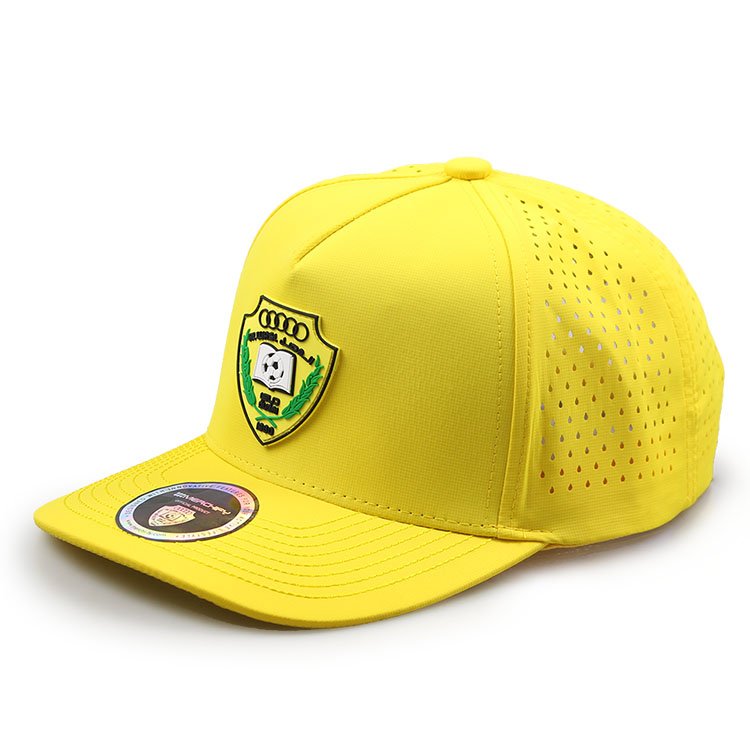
Golf hat materials should be compared as finished fabric systems, not just as fiber names. Cotton, polyester, nylon and blends can all appear in golf headwear, but composition alone does not establish airflow, drying performance, UV protection or comfort.
A useful purchasing specification separates the shell, sweatband, lining, brim support and decoration. Each part can change the finished hat’s feel and care requirements, even when two products share the same outer-fabric label.
What the Main Material Names Tell You
| Material | What to consider | What the name does not establish |
|---|---|---|
| Cotton | Absorbent fiber; check the final fabric’s feel and moisture behavior | Drying time, airflow or UV rating |
| Polyester | Synthetic fiber used in many technical fabrics; verify construction and finish | Automatic moisture wicking or a particular comfort level |
| Nylon | Synthetic option whose fabric construction and treatments need review | Waterproofness or superior performance in every use |
| Blends | Exact fiber percentages and the reason for combining them | The performance of an unspecified “technical blend” |
| Stretch blends | Stretch direction, recovery and interaction with fit | A suitable fit range for every wearer |
Cotton Incorporated’s fiber reference describes cotton’s absorbency. That is a fiber property; it should not be converted into a universal claim that every cotton cap is better or worse for a particular round of golf.
Separate Absorption, Wicking and Drying
Absorption concerns taking up moisture. Wicking concerns liquid moving through a textile structure. Drying concerns removal of moisture through evaporation. These are different purchasing questions, so a report for one should not be presented as a result for all three.
Patagonia describes construction and surface treatments that influence moisture movement in technical fabrics. Low fiber absorbency alone does not establish how a finished fabric transports sweat.
Equally, cotton is not restricted to one moisture profile. CottonWorks describes engineered cotton technology that changes moisture handling. This is an example of why a buyer should examine the actual material and finish, not evidence that any unspecified cotton hat uses that technology.
Compare Construction and Weight
Ask whether the proposed shell is woven, knitted, mesh or perforated, and request its material code and mass per unit area. Compare like-sized swatches where possible. Two fabrics with the same composition can have different constructions and feel different when handled or worn.
Keep fabric weight and finished-hat weight separate. A lining, structured front, sweatband or large patch adds components beyond the shell. If the purchasing objective is a lighter hat, weigh the final decorated sample in the relevant size.
Do not specify maximum openness as a universal goal. A more open appearance raises separate questions about coverage, structure and where decoration can be placed.
Request Evidence That Matches the Claim
| Question | Relevant evidence | Comparison limit |
|---|---|---|
| Does air pass through the fabric? | Air-permeability results, for example using ASTM D737 | Same method, conditions and units |
| How does liquid moisture move? | Appropriate moisture-management or wicking assessment | Do not substitute a drying result |
| How quickly does it dry? | A defined drying test, such as AATCC TM201 where appropriate | Compare equivalent sample and test conditions |
| Does it support a UV claim? | A relevant UV-transmission report | Match material, color and preparation |
| Will it retain the approved appearance? | Finished-sample review after the approved care process | Fabric-only evidence does not cover every component |
AATCC lists separate methods for absorbency, liquid moisture management, wicking and drying. Its TM201 summary describes a heated-plate drying method. These references help define the question to ask; they do not impose a universal pass value for golf hats.
Inspect the Parts the Composition Label Does Not Explain
Review the sweatband against the forehead, the lining inside the crown and the backing behind decoration. Ask for the composition and care requirements of those components where relevant. A soft shell may not compensate for a poorly positioned internal seam.
For stretch fabrics, check recovery after fitting and whether the proposed artwork distorts when worn. For an embroidered design, inspect an actual decorated sample rather than approve it from a fabric swatch and digital logo alone.
Build a Material Specification Before Ordering
Record the shell composition, fabric code, construction, color, weight, finish and required performance evidence. Add the band and lining specifications, size requirements, decoration and care method. Distinguish non-negotiable requirements from preferences so suppliers can propose alternatives clearly.
For a classic retail collection, appearance and hand feel may drive the first shortlist. For repeated outdoor use, drying, coverage and care may carry more weight. In either case, approve the assembled product rather than selecting on a fiber percentage alone.
Send your supplier the intended use, desired fabric feel, artwork and performance requirements. Request identified swatches and a decorated sample with matching material specifications before making a bulk decision. Send your headwear requirements to Shenxiu Outdoors.